



What Kyrgyzstan’s historic election reveals about its evolving role in global affairs
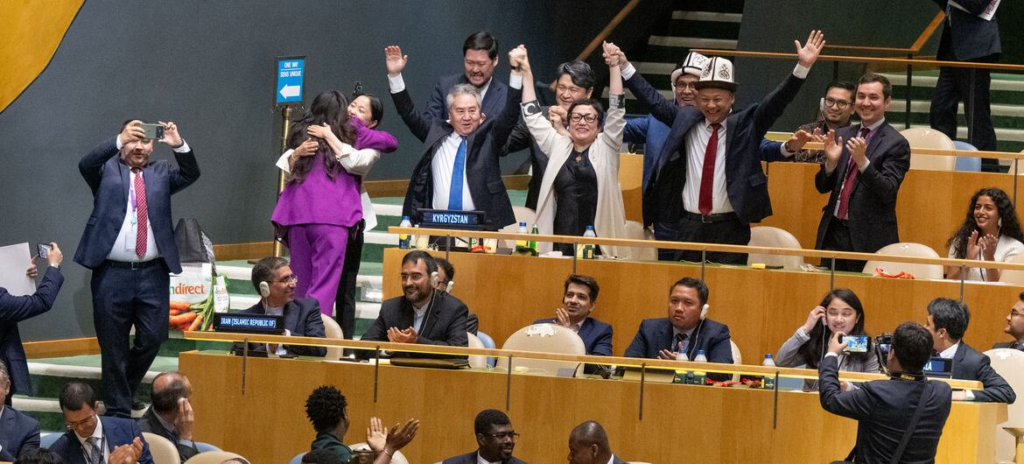
Kyrgyzstan’s election to the United Nations Security Council for the 2027–2028 term marks a defining moment in the country’s diplomatic history. For the first time since gaining independence, the Kyrgyz Republic will serve on the UN’s principal body responsible for the maintenance of international peace and security, participating directly in discussions on some of the most consequential global challenges.
- What Kyrgyzstan’s historic election reveals about its evolving role in global affairs
- From Independence to International Responsibility
- A Landlocked and Mountainous Perspective in Global Diplomacy
- Geography, Regional Cooperation, and Global Priorities
- Conclusion: A New Chapter in Kyrgyzstan’s International Engagement
The achievement carries particular symbolism as it comes during the year marking the 35th anniversary of Kyrgyzstan’s independence. Over the past three and a half decades, the country has steadily developed its diplomatic engagement, expanded its participation in multilateral institutions, and strengthened its international profile. Election to the Security Council reflects this long-term trajectory and represents a new phase in Kyrgyzstan’s engagement with global affairs.
From Independence to International Responsibility
Since 1991, Kyrgyzstan has pursued a foreign policy grounded in dialogue, cooperation, and multilateral engagement. As a member of the United Nations and numerous regional frameworks, the country has consistently supported collective approaches to addressing international challenges.
This orientation is reflected in Kyrgyzstan’s diplomatic messaging at the United Nations, where President Sadyr Japarov has emphasized the importance of dialogue, respect for international law, and peaceful resolution of disputes as guiding principles of the country’s engagement with the international community.
Within this framework, membership of the Security Council represents both recognition of Kyrgyzstan’s diplomatic continuity and a transition toward greater responsibility in global decision-making. The country will now participate directly in deliberations that shape international responses to peace and security challenges.
A Landlocked and Mountainous Perspective in Global Diplomacy
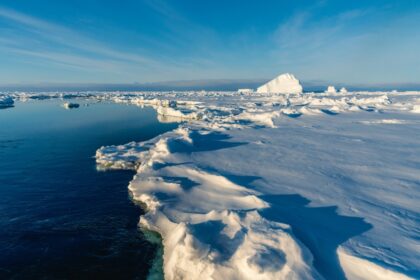
Kyrgyzstan’s geography shapes a distinctive perspective on international affairs. As a landlocked and predominantly mountainous country, it is closely connected to issues that are increasingly prominent on the global agenda, including sustainable mountain development, environmental resilience, biodiversity conservation, and the responsible management of natural resources.
Although Kyrgyzstan has no direct access to the sea, it has demonstrated its commitment to global environmental governance by joining the Agreement on the Conservation and Sustainable Use of Marine Biological Diversity of Areas Beyond National Jurisdiction (BBNJ Agreement). This reflects the understanding that protecting the global commons—including marine biodiversity—is a shared international responsibility that extends beyond geography.
By bringing the perspective of a mountainous and landlocked state to the Security Council, Kyrgyzstan has an opportunity to broaden international discussions on environmental sustainability and the challenges facing regions whose priorities are often underrepresented in global decision-making.
Building on this leadership, Kyrgyzstan will host the Global Mountain Summit in Bishkek in October 2027, providing a high-level platform to advance international dialogue on sustainable mountain development, climate adaptation, and the role of mountainous regions in global environmental governance.
Geography, Regional Cooperation, and Global Priorities
The relationship between climate change, sustainable development, and international security has become increasingly evident. Water scarcity, glacier retreat, ecosystem degradation, and other environmental pressures increasingly influence economic resilience, human security, and regional stability. As a mountainous country whose freshwater resources extend beyond its borders, Kyrgyzstan brings valuable experience to these discussions, particularly on climate resilience, sustainable water management, and environmental cooperation.
At the same time, Kyrgyzstan’s contribution to the Security Council extends beyond environmental issues. As a country situated at the heart of Central Asia, it is well positioned to bring regional perspectives to broader international discussions on peace and security, sustainable development, regional connectivity, and multilateral cooperation. In recent years, Central Asia has attracted growing international attention as countries across the region have expanded dialogue and cooperation while strengthening their engagement with international partners.
Membership of the Security Council provides Kyrgyzstan with an opportunity not only to contribute to discussions on global peace and security, but also to ensure that the perspectives and priorities of landlocked and mountainous states, as well as those of Central Asia, are more fully reflected within the wider international agenda.
Conclusion: A New Chapter in Kyrgyzstan’s International Engagement
Kyrgyzstan’s election to the United Nations Security Council represents both recognition of its diplomatic engagement and a significant step in its international evolution. It reflects the country’s steady integration into multilateral structures and the confidence placed in it by the international community.
As Kyrgyzstan prepares to assume its responsibilities on the Security Council during the year marking the 35th anniversary of its independence, it enters a new phase in which its voice will be present in high-level discussions on international peace and security.
The election is not only a milestone in Kyrgyzstan’s diplomatic history. It also provides an opportunity for the country to contribute to international peace and security while bringing perspectives shaped by its experience as a landlocked and mountainous state, its commitment to multilateral cooperation, and its position at the heart of Central Asia.
In this sense, Kyrgyzstan’s membership of the Security Council marks both continuity and evolution: continuity in its longstanding commitment to multilateral diplomacy, and evolution in its growing role as a constructive contributor to international peace, cooperation, and global governance.





Great content! Keep up the good work!